 Instaswap
 fees depend on the selected route, while total route costs determine the amount a recipient receives
Updated ·
Instaswap fees vary with the selected route rather than following one universal charge. A quote may reflect a service margin, underlying protocol costs, network charges, a route's execution spread, and an integration fee. Compare identical inputs by the final estimated output, then confirm what each disclosed component includes.
The short version: Compare identical inputs by final receive amount, then use the fee breakdown to explain route, network, spread, and partner differences.
Charges inside a swap quote
A swap quote can combine five economically distinct cost layers, although a particular route may not use every one. Separating them prevents a low service fee from hiding a costly network path or weak execution price.
Service and route charges
The service margin is incorporated into the quoted execution rather than imposed as one flat percentage across every swap. Instaswap's route-dependent swap fee is approximately 0.3% to 1.0%, with the exact figure varying by protocol, pair, size, and market conditions. An underlying liquidity protocol may also impose its own execution cost, which becomes part of the route economics.
Network costs
Network charges pay for blockchain transactions needed to move or settle assets. Congestion and the chains involved can change this amount, and a small swap may feel the effect more sharply than a large one. The quote breakdown can identify the charged asset and provide a common-value equivalent, while a separately signed deposit transaction may create another source-side cost.
Spread and integration adjustments
Execution spread is the difference between a reference market price and the effective price available through the chosen liquidity path. It affects value received but is not necessarily a separate payment to one recipient. A partner or embedded integration may add a configured fee, and that item should remain distinct from the platform margin and protocol costs.
The final receive amount reflects these layers. A percentage line alone cannot show which route returns the highest output for the same request.
Route selection changes the cost mix
Route selection changes the protocol, liquidity, network activity, and execution price behind a quote. The routing process considers expected output alongside gas cost, slippage, and reliability. A route with a higher service component may still return more of the output asset when its network burden or spread is lower. Conversely, the smallest visible percentage can accompany a weaker final amount.
A reproducible comparison method
A sound comparison holds the transaction request constant and evaluates every candidate at nearly the same time. Changing the amount, network, output asset, or integration context creates a new request rather than another price for the old one.
Fix the comparison boundary
The comparison boundary includes the input and output assets, their networks, the deposit amount, settlement mode, destination requirements, and quote time. Each candidate must describe that same boundary. If one field changes, refresh every candidate before drawing a conclusion.
Normalize the disclosed costs
Disclosed charges may use different assets, so compare their common-value equivalents at one observation time. Keep separately paid source-network costs in the calculation. Do not add a spread line twice when the expected output already reflects that price effect.
Rank by the amount received
The expected output is the cleanest first comparison when every input is identical. For a percentage view, divide the difference between the input reference value and expected output reference value by the input reference value. Add any external transaction cost that the quote does not already include.
A worked comparison with changing cost inputs
Every numeric input in this worked example is hypothetical. Both quotes use the same input asset, output asset, networks, observation time, and input value of 846.00 accounting units. Only the route charge, network cost, and price effect differ.
Quote A contains a route and service charge of 6.76 units, a network cost of 2.14 units, and a spread effect of 4.62 units. Its combined cost is 13.52 units, leaving an estimated output value of 832.48 units. The effective cost rate is 13.52 divided by 846.00, or about 1.60%.
Quote B contains an 8.26-unit route and service charge, a 1.18-unit network cost, and a 2.46-unit spread effect. Its combined cost is 11.90 units, leaving 834.10 units. Quote B therefore returns 1.62 more accounting units despite carrying the higher route charge.
The comparison stops being valid if either quote expires or any request field changes. If Quote B expires during the decision, refresh both quotes with identical inputs. A stale output and a live output do not form a reproducible comparison.
Payers and recipients behind the breakdown
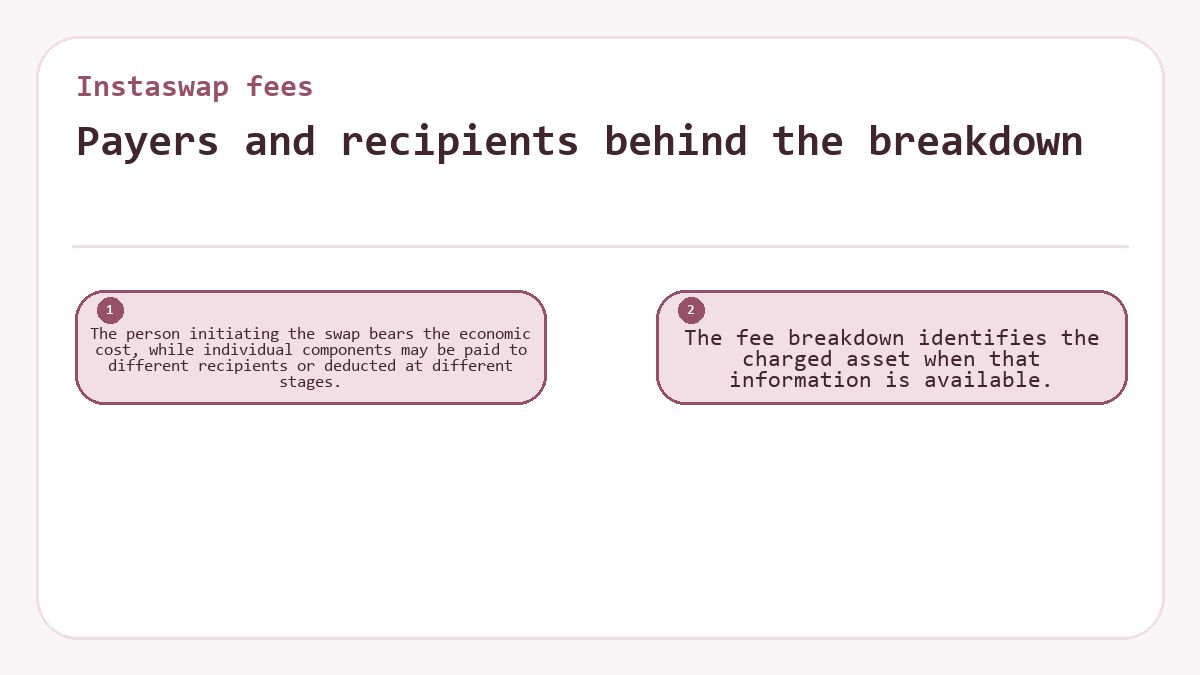
The person initiating the swap bears the economic cost, while individual components may be paid to different recipients or deducted at different stages. The fee breakdown identifies the charged asset when that information is available.
The swap initiator
The initiator bears the cost through the deposited amount, a separately paid network transaction, a reduction in output, or a combination of these mechanisms. This is why the deposit's reference value minus visible fee lines may not equal the received output's reference value when the execution price also moves.
Networks and liquidity protocols
The selected blockchain applies its own transaction rules, while the underlying protocol determines its liquidity and execution charges. Network cost may be consumed or distributed according to that chain's design. Protocol charges follow the selected route's rules rather than one Instaswap-wide schedule.
Partners and the output recipient
A configured partner fee is paid to the integration partner and may be split with a sub-partner. The output recipient receives the settled asset amount after the route has applied its costs and execution price. That recipient may differ from the person who supplied the deposit.
Why can the final cost differ from the quote?
The final cost can differ because the quoted receive amount is an estimate for a particular request and moment. Market movement between quoting and execution, network congestion, and the selected route's execution characteristics can change the settled output. A larger difference is not automatically a new platform charge; check the transaction record and any available fee breakdown before attributing it to a platform charge.
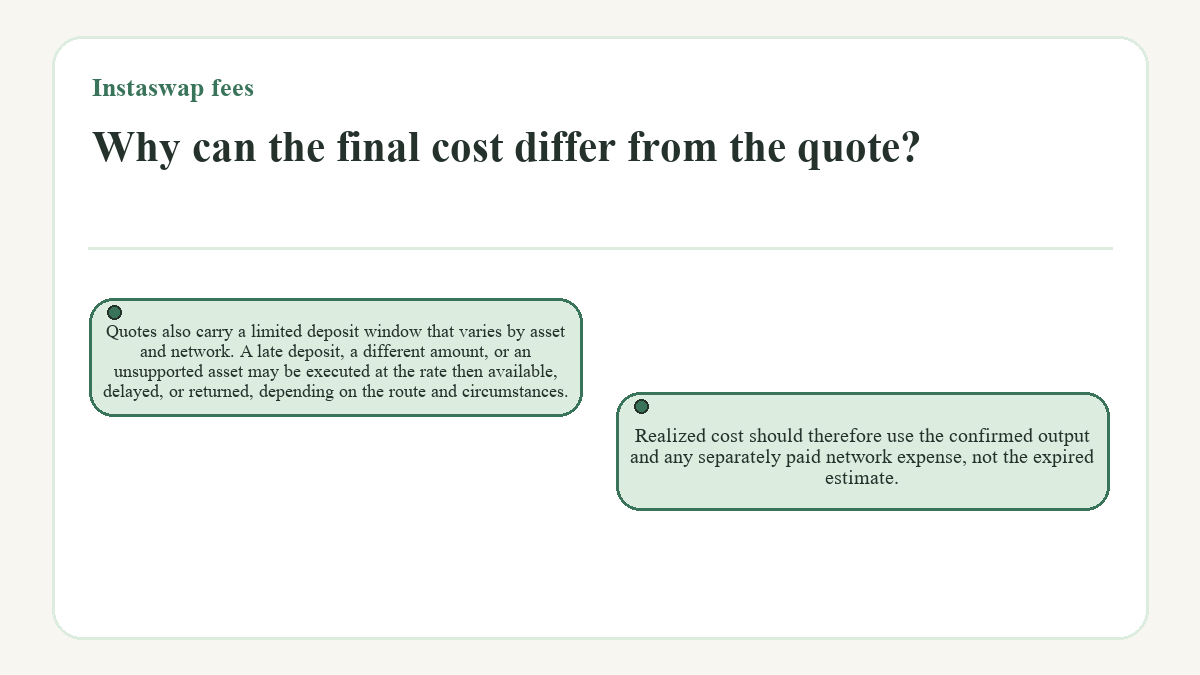
Quotes also carry a limited deposit window that varies by asset and network. A late deposit, a different amount, or an unsupported asset may be executed at the rate then available, delayed, or returned, depending on the route and circumstances. Realized cost should therefore use the confirmed output and any separately paid network expense, not the expired estimate.
Funding payments for perpetual positions
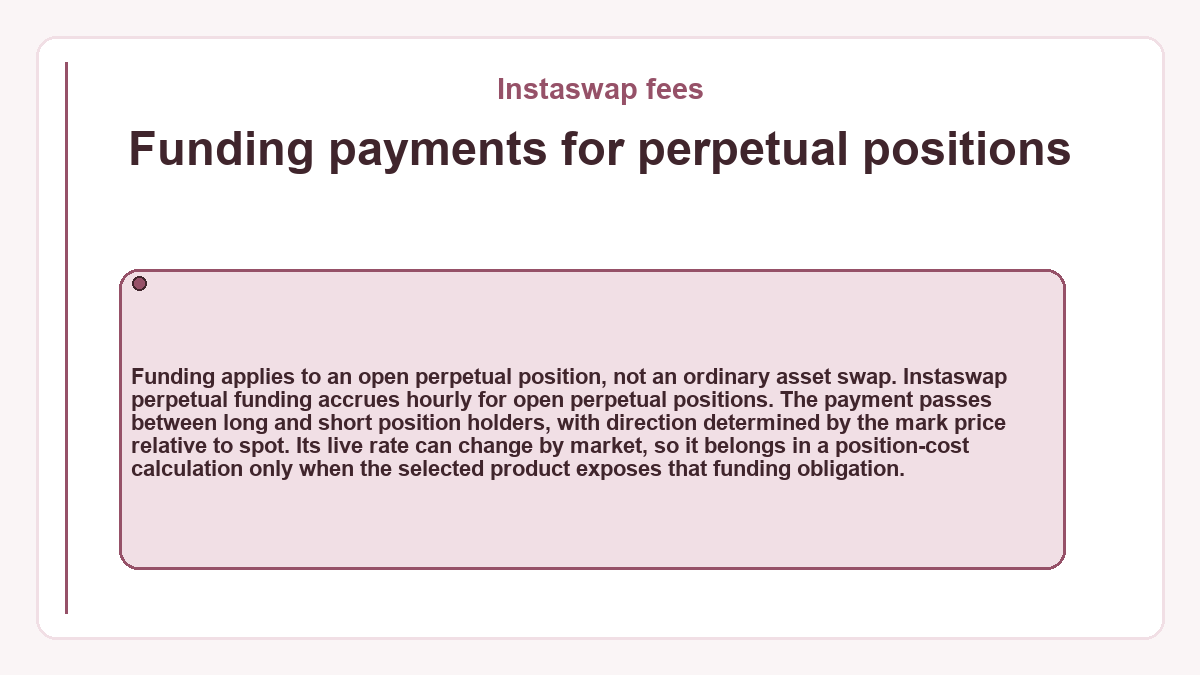
Funding applies to an open perpetual position, not an ordinary asset swap. Instaswap perpetual funding accrues hourly for open perpetual positions. The payment passes between long and short position holders, with direction determined by the mark price relative to spot. Its live rate can change by market, so it belongs in a position-cost calculation only when the selected product exposes that funding obligation.
Records that preserve the comparison
A useful comparison record preserves the request and the values used to judge it. Retain enough detail to distinguish a live route change from an arithmetic or bookkeeping error:
- the input and output assets with their selected networks;
- the deposit amount, quote time, and displayed validity window;
- the expected output and itemized fee breakdown;
- the route or integration context attached to the quote; and
- the confirmed output plus separately paid network costs.
The quote explains the proposed cost before commitment, while the settlement record shows the realized amount. The combined record supports a like-for-like review, but it does not restore an expired quote or eliminate price movement between pricing and settlement.
Helpful answers
Is the stated fee range a guaranteed maximum for every route?
No. The approximately 0.3% to 1.0% figure describes a route-dependent swap fee range, not a contractual ceiling on all-in cost. Network charges are separate, partner fees may apply through an integration, and spread can affect received value. The relevant figure for a particular request is the complete live quote with its inputs and fee breakdown.
Can a lower network charge still produce a smaller receive amount?
Yes. A route with cheaper network execution can carry a higher service or protocol cost, or it can execute at a less favorable price. Keep the input, output, amount, networks, and quote time constant, then compare the expected receive amounts. The network line explains one part of the difference, not the whole cost.
Does an API integration add a separate partner charge?
It can. Integration partners may configure a fee on top of the base execution cost, and sub-partner arrangements can divide that amount. Where these charges apply, the fee breakdown identifies the partner components. Treat quotes from different integration contexts as separate offers, even when their asset pair and deposit amount match.